How to Choose a Spice Supplier for Your Restaurant or Food Business
The best spice supplier for restaurants is the one that delivers fresh, consistently ground product every time, can blend to your recipe, labels it the way you need, and answers the phone when something goes wrong. Price matters, but stale or inconsistent spices cost more in the long run than a slightly higher invoice.
Spices are a small line on the food cost sheet and a large part of how your food tastes. A signature shawarma or a house curry lives or dies on what is in the shaker.
Kashat supplies home cooks, restaurants and food manufacturers in over 10 states from our shop in Madison Heights, Michigan, so we hear the same questions from every kitchen that comes to us. Here is what to look for, what to avoid, and what to ask.
What should you look for in a spice supplier for restaurants?
Look for eight things: freshness, consistency, custom blending, labeling options, reliable delivery, workable minimums, samples, and a real person who answers. A supplier that fails on freshness or consistency is not worth a discount, because you pay for it later in flavor.
Freshness and grind date
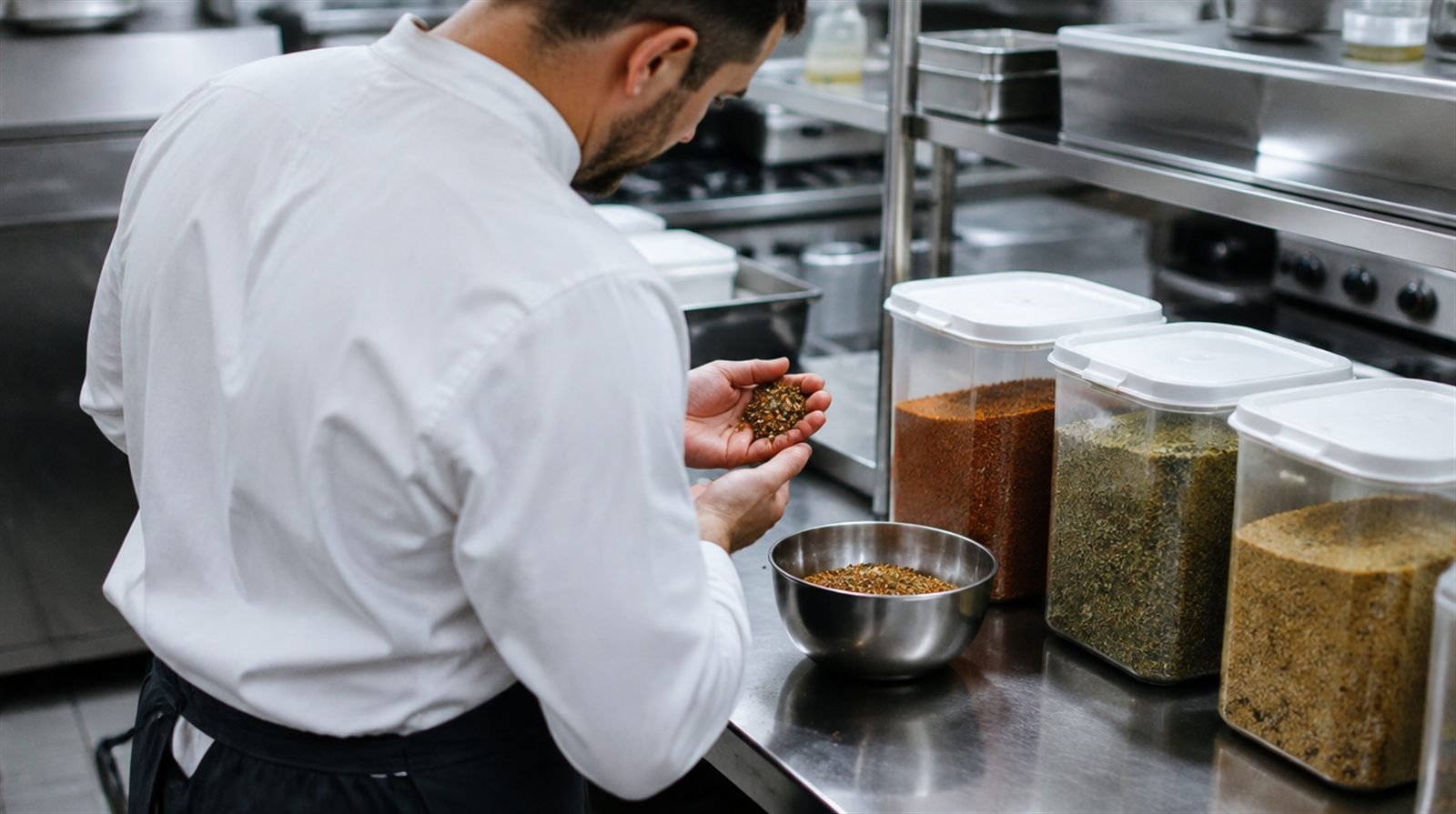
Ask when the spice was ground, not when it was packed. Ground spices lose aroma fastest, so a supplier who grinds close to shipping, in small batches, gives you a stronger product at the same weight. If they cannot tell you, assume it has been sitting.
Consistency batch to batch
Your regulars expect the shawarma to taste the same in March as it did in October. Ask how the supplier keeps blends consistent, which usually means a written recipe, steady sourcing and someone tasting each batch. Ask for two lots and compare them side by side.
Custom blending
If you have a signature seasoning, you want a supplier who can blend it to your recipe and keep that recipe confidential. Many distributors only resell what a manufacturer makes. A blender who mixes in-house can match your existing mix, adjust it, or build a new one with you.
Labeling and packaging options
Decide whether you want the supplier’s label, your own label, or a plain white label, and whether you need retail jars, foodservice tubs or bulk bags. Private label and white label are not the same thing, and our guide to private label spice blends explains the difference.
Delivery reliability
Ask how orders ship, how long they usually take, and what happens when something arrives damaged or short. Get the answer in writing before you depend on it, and find out whether there is a person to call when a delivery goes wrong.
Minimums, samples and communication
Ask about minimum orders up front and ask for a sample before you commit. Then notice how the conversation goes. A supplier who answers questions clearly before the sale is the one who will answer them after it.
What are the red flags with a bulk spices supplier?
The biggest red flag in a spice supplier for restaurants is one who cannot or will not tell you when the product was ground. After that, watch for these.
- Dull color, weak aroma or clumping in the sample.
- No answer on grind date or lot number.
- Refusal to send a sample before a first order.
- Blends that taste different from one order to the next.
- Fillers, anti-caking agents or artificial additives that are not on the label.
- Every question routed to a catalog or a ticket instead of a person.
- Pressure to commit to large volumes before you have cooked with the product.
What questions should you ask a restaurant spice vendor?
Ask these before the first order. The answers tell you as much as the sample does.
- When was this ground, and how often do you grind it?
- Do you blend in-house, or resell another manufacturer’s blends?
- Can you match my current recipe from a sample, and will you keep it confidential?
- What are your minimums for single spices, house blends and custom blends?
- What label and packaging options do you offer?
- Is there anything in the blend besides spices, herbs and salt?
- How do orders ship, and who do I call if something is wrong?
- Can I get a sample first?
Why can a small-batch regional blender beat a national distributor?
For signature flavors, a small-batch blender wins on freshness, flexibility and access. A national distributor wins on catalog breadth and one-stop ordering. Many restaurants that care about how their food tastes use both: the distributor for commodity items, and a blender for the spices that define the menu.
| Factor | National distributor | Small-batch regional blender |
|---|---|---|
| Grinding | Often ground well in advance by the manufacturer, then warehoused | Ground in-house, close to shipping |
| Custom blends | Rarely; resells existing products | Yes, matched to your recipe |
| Private and white label | Sometimes, often only at high volume | Commonly offered; ask for details |
| Who you talk to | A sales rep or an ordering portal | The people who blend the product |
| Catalog | Everything from paper goods to produce | Spices, herbs and blends only |
| Best for | Commodity items, one-stop ordering | Signature blends, Middle Eastern flavors, freshness |
That is the model we run at Kashat. Spices are ground fresh in-house and hand-mixed in small batches with no artificial preservatives or additives. We offer our own Kashat label, private label, white label and custom blends to restaurants and food manufacturers in over 10 states. Wholesale is not sold through the website. It starts with a conversation through the Kashat wholesale page or an email to randy@kashatspices.com.
How do you switch spice suppliers without disrupting the kitchen?
Switch one blend at a time, and test before you commit. A new spice supplier for restaurants should make your food taste more like itself, not different, and a staged switch is how you make sure of that.
- Cook one dish two ways, with the old spice and the new, and taste them side by side with your cooks.
- Start with the blend that matters most to the menu, and switch the rest only after it proves out.
- Keep a labeled reference jar of the approved batch so future deliveries can be checked against it.
- Write dosing into your recipes by weight, since a fresher spice may need less.
- Set a reorder rhythm before you run low, so you are never buying in a hurry.
Frequently Asked Questions
How much do wholesale spices for restaurants cost?
It depends on the spice, the volume, and whether it is a single spice or a custom blend, so any supplier will need to quote your specific list. When you compare quotes, compare on flavor per dollar rather than weight per dollar, because a fresh, strong spice goes further in the pot than a stale one. Ask each supplier for a sample and cook with it before you decide.
Do spice suppliers have minimum orders?
Most do, and the minimum varies widely between a national distributor and a small blender, so ask each one directly. Some set minimums by dollar amount, some by case, and some by blend. A custom blend often has its own minimum because it is made to order. Get the number in writing before you plan your first order around it.
Can a spice supplier make my restaurant’s signature blend?
Yes, if the supplier blends in-house. A blender can match an existing recipe from a sample, adjust it, or develop a new one with you, and then pack it under your label. Ask about confidentiality, how they keep the recipe consistent from batch to batch, and how reorders work. Kashat offers custom blends along with private label and white label for restaurants and food manufacturers.
How do I order wholesale spices from Kashat?
Wholesale is not sold through the online shop. Start with the form on the wholesale page or send an email to randy@kashatspices.com with what you are looking for: single spices, house blends, or a custom recipe, plus your rough volume and how you want it packed. We blend in small batches in Madison Heights, Michigan, and ship to restaurants and food manufacturers across multiple states.
Start with a sample and a conversation with a spice supplier for restaurants that grinds fresh. Fill out the form on the Kashat wholesale page or email randy@kashatspices.com, and tell us which blend on your menu you want to taste fresher.